A Concert Memory in Three Lines
A concert memory in three lines helps you retain one sound, one change and one open question without turning a vivid evening into a long review.
A concert memory in three lines is enough to keep a live performance distinct in your mind: note one sound, one moment of change and one question before the evening blurs into general impressions. Write them soon after the music ends, while a particular entrance, silence or shift in texture is still easy to recall. The aim is not to judge the performance but to preserve three handles for remembering it.
What should each line capture?
Give each line a different job. The first records a sound you can describe; the second marks a change you noticed; the third leaves a question you might carry into another listening. This small structure helps you avoid writing three versions of “I liked it.”
- One sound: name a specific timbre, gesture or combination of instruments.
- One moment of change: describe what shifted and when you sensed it.
- One question: record something you are curious about, not something you need to solve immediately.
Keep the sound concrete. “The low strings felt warm” is a starting point, but “the low strings held a dark, even tone beneath the flute” gives you more to recognize later. You do not need specialist vocabulary; a comparison to a familiar object or sensation can be clearer than a technical term.
For the change, look for a transition rather than a grand climax. Perhaps a busy passage thinned to a single line, a repeated rhythm became insistent, or a pause altered the room’s sense of time. Your question might ask what made that shift feel sudden, or whether a detail you heard came from one instrument or several.
When is the right time to write it down?
Make the note after applause and greetings, once you can give the music a moment of attention without blocking the exit or conversation. If you are leaving a crowded hall, wait until you have reached a quieter place; a hurried impression is still useful, but it need not be written while people are moving around you.
Choose a method you can use without fuss. A small notebook suits anyone who likes handwriting, while a notes app is convenient if your phone is already in hand. A voice memo can preserve a phrase when typing feels distracting, but keep it brief and speak quietly away from other listeners.
Do not force yourself to complete a polished sentence. A fragment such as “oboe over soft pulse; texture suddenly opened; why did the silence feel tense?” already contains all three parts. The note is a bookmark, not a review for an audience.
How can you describe a sound you cannot name?
Describe what the sound did before trying to identify its source. You might write that it was bright, grainy, ringing, breathy, clipped or sustained, then add where it seemed to sit: above the ensemble, underneath it, or at the edge of the texture.
If you think you recognized an instrument, mark that as an impression rather than a certainty. In a large hall, blended sounds can be difficult to place, and an uncertain label can distract from the quality you actually heard. “A thin, high line answered the strings” remains useful even if you later learn it came from a different instrument than you guessed.
One plain analogy can make an impression easier to retrieve. A repeated figure might have felt like a spoon tapping a glass: not because the music literally sounded like that object, but because the comparison captures its light, recurring attack. Use a comparison only if it clarifies something specific.
What counts as a moment of change?
A change is any shift that altered your attention. It might be a move from full ensemble to a solo voice, a change in volume, a new pulse, a sudden stillness or a return of an earlier musical idea. You do not need to know the formal name of the passage.
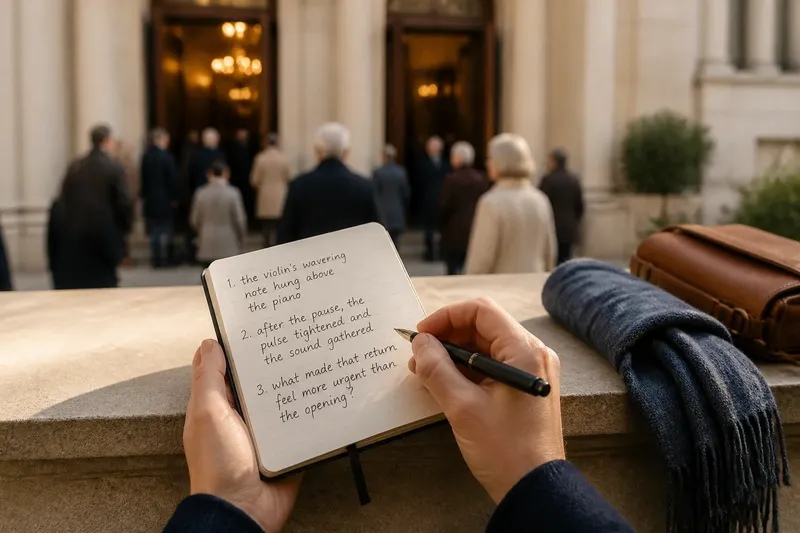
Imagine you leave a chamber concert remembering a soft, wavering violin note, then recall that the ensemble grew more active just after a quiet pause. Your three lines could say: “The violin’s wavering note hung above the piano”; “after the pause, the pulse tightened and the sound gathered”; “what made that return feel more urgent than the opening?” The details are specific enough to bring back the experience without claiming to explain the music.
When a performance seemed continuous, choose the point where your attention changed instead of searching for a dramatic event. Perhaps you noticed the hall’s resonance, followed a new instrument, or stopped tracking the beat. That change in listening is part of your memory of the evening.
How should you write a useful concert memory?
Use your own language and keep each line short enough to scan later. A useful note has a sensory detail, a clear contrast or transition, and a question that invites another listen. It need not include the composer’s biography, a rating or a verdict on the performers.
Try these checks as you write:
- Can you point to a sound rather than only naming a mood?
- Does the change include a before and an after?
- Is the question open, rather than a disguised judgment?
- Have you kept a guess about an instrument or technique separate from what you directly heard?
- Can you read the lines later and remember which moment you meant?
If a line remains vague, add one audible clue. Replace “the middle was exciting” with “the steady bass pattern continued while the upper strings entered in short bursts.” If you cannot recall more, leave the note as it is rather than filling the gap with an explanation you did not hear.
What can you do with the note later?
Read it before listening to the piece again, if you have access to a recording, or before attending another concert with related music. Your note can direct attention without dictating what you should hear. You might listen for the return of the sound you marked, or see whether your question becomes clearer.
Keep later impressions separate from the original three lines. Add a brief dated follow-up if you want to record what changed in your understanding. This preserves the first response as it was, while allowing your memory to develop rather than treating the initial note as a final interpretation.
A concert memory in three lines works best when it stays small: one identifiable sound, one audible turn and one honest question. Put the note somewhere you can find it, and let the question remain unanswered until another encounter gives you a reason to listen differently.